Wednesday, June 1, 2011

Showman Doyle Longsdorf ~ Pioneer of the Month ~ June 2011

MEMORIES of Showman Doyle Longsdorf (1857 – 1935)
I, Showman Doyle Longsdorff, was born in Churchtown,. Pa. April 12, 1857. My parents were Augustus Emanuel Longsdorff, born July 7, 1834, died, January 21, 1898, aged 64 years; and Catherine Elizabeth Wonderly' (Wundelich) born February 18,1829, died August 13, 1907, aged 68 years. Of my father’s family I have very little record. My grandfather, Michael Longsdorff and my grandmother, Mary Hannon Longsdorff, lived in Churah­town Pa. My grandfather at one time owned a great many acres of rich farm and timber land in the eastern part of Cumberland County, Pennsyl­vania, and at one time he was sheriff of the county. I have heard my mother tell that at that time there was a law that everything, even a baby’s cradle, could be sold for debt.
Through grandfather’s generosity while serving as sheriff and by signing notes for people, he lost practically all, and. very 1ittle was left for the family. He donated to the city of Kingston, Pennsylvania the plot of ground used for their cemetery.
My father had a brother Dr. Adam G. Longsdorff of Wichita, Kansas. Prior to locating there,
he had served as a state senator in' Maryland There was           Showman Doyle Longsdorf
also a. brother Harmon who moved to Ohio and one George
of Pennsylvania. A sister Elizabeth whom we called Aunt Betsey who married Jacob Kline and lived in Camp Rill Pennsylvania; and Aunt Louise, whose first husband was named Doyle for whom I was named. After his death
she married Josiah Helligas, who served as a member of the Pennsylvania Legislature 1856-1858, from Montgomery County,  Pa..and there was a sister Mary L. Cook also of Pennsylvania.
The name Wonderly is derived from Wunderlich and earliest records of this name are found in the records of Kotelen, Germany in 1848. One Hans Wunderlich, who had his name translated into French, calling himself Mervieleus. Some of his descendants continued to use this trans­lation while others resumed the name of Wunderlich.. Johannes Wunderlich, my great, great, great, great grandfather, was born in 1700, died in 1760. His wife, Anna Barbara Densler, my great, great, great, great grandmother, was born in 1702 and died in 1765. Records from then on are published in a volume called, “Genealogy of the Wunderlich Family in America" This record shows that members of this family held many important positions of trust in Germany, France, Switzerland, and America..
My parents had ten children. 
 They were:                      
                       Showman  Doyle Longsdorf                              Born April 12, 1857                         
 Died January 9, 1935

           Ella Louise Longsdorff                                        Born Deoember 4, 1858
 Died January 29, 1931

            Michael Herbert Longsdorff                               Born August 30, Died 1860

           Emma Jane Longsdorff                                    Born July 19, Died1863

           Flora May Longsdorff                                        Born November 17, Died 1865

                                              Berties Lerene Longsdorff                                  Born Apri1 28, 1868

                       George Wonderly Longsdorff                            Born December 3, 1870
                                                                                                Died March 22, 1873    
                    
                        Elizabeth Bell Longsdorff                                  Born July 3, 1873
                                                                                                  
                       William Landen Longsdorff                                Born July 13, 1876
                                                                                                
                       Alice Longsdorff                                               Born March 12, 1879

                                                                                                Died April 8, 1879


             As I was the first child, they undoubtedly   thought me a wonder and I was named in honor of the family's minister ------ Showman , and an uncle, Doyle. As I was very young I had not any say in the matter.
My father was a shoemaker by trade; then being a shoemaker meant a maker of shoes, as most all boots and shoes were hand-made. In those days, factory-made shoes were very few. Father was a real artist in his line and took real pride in turning out fine work. He received $20.00 a pair for boots. One of his customers was Captain Addison Moore who had married our cousin, Elizabeth Kline, a daughter of Aunt Betsey. The last pair of boots he made for the Captain was in 1886, just before he left Pennsylvania for Kansas.
Although father worked steadily and fast, be could hardly support his large family. I remember when I was four or five years old I contracted a very severe case of smallpox, my face and hands were solid scabs. I remember people coming to the window and looking at me. There was at that time a photo taken of me showing the horrible condition I was in.  I had contracted the disease from my father who had had it in a mild form. He in turn had contracted it from a corpse whom he prepared for burial.
I remember my father as being strict, expecting the children to be respectful and obedient. We could sometimes work mother, but when father told us to do a thing we did it. When we were at play on the street and he wanted us, he would give a shrill whistle, and believe me we would immediately go to him
I remember every night my mother would gather her children to her and we would kneel about her knees and say our prayers. It is something I often think about. During the rebellion (Civil War) my father, although not called to serve, was drafted, and as my mother was unable to care for her brood, the children were sent to relatives. Emma went to live with Aunt Louise Helligas, Ella to live with Uncle Strauck and I with grand­father Wunderlich. Michael Herbert was the baby at that time.
My grand­parents were very religious and lived their religion. They would not allow any work whatever to be done on Sunday. .Al1 preparation for that day was made on Saturday. Every day we held a prayer in the morning. Blessing at noon and singing of hymns or reading from the Bible at night. On Sunday we would attend Sunday School, then a sermon, home for dinner and to feed the stock and back to church again for evening service. Every Wednesday night we attended prayer meeting.  We never beard an oath or a smutty word at his house
After three or four years I returned home, but E11a and Emma stayed with the Aunts until they were married. Ella married Harry Gardner who for years was a carpenter instructor in the Carlyle Indian School.  Emma married his brother, Ben Gardner, who held some church positions. I remember a while after I came home, Herbert and I decided we wanted to visit with Emma at Aunt Louise's, a distance of about ten miles. One Saturday, we rode there with a market team; after we arrived Aunt Louise was scolding about something, and it struck us we were not very welcome. Although; we had intended to stay over Sunday, we hoofed it back home very early in the morning. Oar father thought this a big joke and .made a great deal of sport of it.
As we were a large family, it was necessary for us to get out and hustle as soon as we could. I had very little schooling, As soon as I was through with one job, someone else was there with another. I was about twelve years old when I got my first steady job. I worked for Will Loose on his farm, living with his family. My wages were turned into our family. I get out of it a suit of clothes a year and in the late summer I wore cotton trousers made by my mother and I went barefoot until mighty near winter. Father was too busy making shoes for others to make shoes far his children.
When I was about 19 years old, my uncle, Dr. Adam J. Longsdorff, who was visiting in Pennsylvania, asked me how I would like to go west and work on his farm and that suited me. I went to Wichita and worked there for several years. Soon after I arrived my uncle took me to a play featuring "Belle Golden". I was 19 years old and it was the first show I had ever attended. I 1aughed so heartily that the audience laughed at me instead of the play, but it, being the first I had ever seen, it naturally was the funniest. I remember we burned a great deal of corn there on the farm for fuel because it was cheaper and handier than getting coal.  At that time, it was eighteen cents a bushel.
My uncle did not seem to have much use for General George B. McClellihan. He claimed he could have ended the Civil War sooner had he cared, yet I remember my father, who belonged to the Drum and Fife Corps, had marched and paraded for McClellihan when he ran for President of’ the United States and was defeated by Abraham Lincoln -- so that was just the difference of opinion. My uncle bad a good practice. I remember during the Scarlet Fever epidemic he had fifty or more cases and it kept him going day end night. One night a call came for him and I beard him say to Aunt Maggie, "Tell them I just can't go," but after a while he said no, I had better go; I know the younger Dr.'s won't so I must." He then hitched up his two little ponies and drove away in his especially made light buggy. Sometimes his calls would take him twenty or thirty miles away. He always carried matches with him, so in case of a large prairie fire he would have a chance to back fire and get away. In his younger days, he, as was the custom, wore a long beard. It was dark brown and silky, so long he would wrap it about his neck and tie it as a muffler.
He and Uncle ------ Doyle some years before had traded in Negroes. They, at that tine, were bought and sold and branded with a hot iron as were cattle. Uncle Doyle died, and Uncle Adam, although not a religious man, claimed Uncle Doyle carne to him and said, "Adam, don't buy any more negroes”, and Uncle Adam did not buy any more negroes. Those he had were freed but some refused to leave saying that it was as good a home as they needed.
My uncle wanted to educate my brother, Herbert, to be a doctor to take up his practice, as he felt he was getting old--too old to attend to it. He sent him to a medical school for two years and one day Herbert said he didn't want to be a doctor. Uncle did not argue with him, only said it was up to him, Herbert then quit school and got a position in a grocery store.
During the winter of 1878 or 79, Cousin Louise, Uncle Adam's only daughter and I made a trip to Pennsylvania--my first trip back. We laughed after about an experience there. Father bad two hogs in a pen fattening for winter; they got out and Sister Flora and I were running after them to get them back in the pen. One hog got caught between the double gate and Flora caught it by the tail. I called to ber to hold on until I could get there but, with the hog pulling one way and: Flora the other, the hog got trough. the gate and when he did, Flora fell backward with most of the pigs tail held tightly in her hands. After this, we had a great deal of sport with her about pulling the pig's tail.
My father had obtained a good position in charge of a boy's dormitory in a large school and had been comfortably located, but the lure of the West was with him and he and the :family came to Wichita to live. Sister Flora, in the meantime bad married a man named Warren Stiteler' and was living in Virginia. He, after some years, died, leaving her with six children. She later married J. Holmes Moore. Cousin Louise had first married a captain in the army from whom she had later separated. uncle Add had taken a great fancy to her daughter, Annie, and bad insisted on adopting her, so she was always known as Annie Longsdorff. She, cousin Louise, later married a man named Long. This marriage was also a failure, as he proved to be a worthless sort of a fellow. It was during the time he was on Uncle Add's (Adam’s) farm, and I thought perhaps I was not .needed there, that I decided to get some other kind of work.
I went to Arkansas City, Kansas to work for John Kronert, Retail Grocery Company, but there was excitement about cowboys and cattle and I got it into my head that I wanted to be a cowboy. This caused my mother considerable worry for she thought I was not strong enough for that kind of life, and Indians and cowboys meant nothing but danger to the easterner. I still wanted to be a cowboy, so I went to the Indian Territory--not Oklahoma. While there, I developed a bad case of typhoid fever through drinking impure slewey and stale water. They took me back to Wichita to my Uncle Add (Dr. Longsdorff) . I remember he held me in his arms, and I beard him say, "I am afraid he won't last until morning." But I fooled them, and after a while I was looking for a job again.
I knew I could always go back; places where I had formerly worked, so I went back to Scott Corbett, one of my, places. He said he could not pay me what he should, but I wanted something to do and I told him to never mind the price, just so I could live. He hired at a price named, but always paid me extra. After a while I went back to John Kronert Grocery Company in Arkansas City.
Cousin Louise had been in a number of runaway accidents and was in very poor health. She spent a great deal of time at Geuda Springs, Kansas and other health resorts. She had beard a great deal about the curing powers of the Great Salt Lake, Utah and was very anxious to try it. Uncle Add wrote me at Arkansas City, asking me to go with her to Utah.
Her daughter Annie had married George Amborn in December 1886 and my sister had married Birdie had married Dr Levi Cook on June 1, 1887. My brother, Herbert, had married Elizabeth Homer, May 1887.
Louise and I came to Utah early in the fall of 1887.. The first place we lived was 555 South West Temple in part of Heber C. Clyde’s place and we had a hard time getting along. I would ask for a position and they ask if I was a member of the church, and as I was not, there did not seem to be an opening for me. Finally I presented to Mr. Cartright, at D. & R. G. a letter of introduction from his brother in Arkansas City. When I was given this letter, I thought I would not use it, but I needed work and was given a job trucking and unloading freight. I had not been used to such heavy work and it was hard on me yet I held the job for about a year and a half. We then moved te Seventh South, and from there to South Temple. Here we made acquaintance of one of Brigham Young’s daughters--I do not remember her name--who lived across the street and did us many good turns.
We moved to 200 East, Second south, and Louise, although ill, with the help of Tina Lund, of Mt. Pleasant, Utah, run a bearding house. One good friend I'll never forget was the Bishop of Bountiful, Brother Ashby. He sold vegetables and many a time he left with us the unsold stock, which was a great help to us. I thought him one of the finest men I had ever known.
I quit the D. & R. G. and get a job with Applegate and Busby Commission Co. and later. I worked for E. G. Hines Commission House for several years. My cousin died November 19, 1891 and her body was sent to Wichita for burial. Tina Lund was still with us and helped a lot at this time. Also Bishop Ashby again befriended us in helping to get the body prepared for shipment. There was no undertaker at that time.
There was a watch maker who boarded with us who did a great deal to help us. Brigham Young’s daughter was there also. A Mr. Empy who was con­nected with Clark Eldredge Co. proved a mighty good friend to me too. I had gotten acquainted with him some years before. He was taking subscriptions at that time for the Salt Lake Temple which was twelve feet high, when I came to Utah. The rock, for this foundation had been hauled by ox team. I told him I had no job and not much money but I wanted to give $1.00, enough to say I helped build the Mormon Temple.
There was a time while I was delivering for Hines Commission Co. that I thought I knew just about everyone in Salt Lake City. My parents wrote me that Elizabeth wanted to marry a man by the name of O. J. Riley. This man the folks did not like very well, but Elizabeth later however, married him in spite of their objection, and he proved to be a very fine type. He was some years later killed in a Railroad accident in Perry, Oklahoma. She afterwards married a man by the name of Wageok. Uncle Add died August 3, 1893 and his wife, Aunt Maggie, died October 27, 1894.
George Haverstic, a cousin of mime and Carl Mauck were working for Hines at the time I was. I often heard them talking about Sanpete County buying calves etc. Mauck had been in the county and bad been told that it was the best in the state. He and Haverstic started out with a team. They were only gone a half a day when they gave up the trip and returned to Salt Lake. Mauck still wanted to go. He then talked to me and I told him if he wanted to go I would go with him, but if he stepped I would go on. He then went to Cash Co. and bought a team and we had a buggy fixed to order, suitable for buying calves, eggs, etc., and we started out, by way of Thistle. He with the team and I on my bicycle. It had been raining and the roads were holy terrors. We arrived at Mt. Pleasant on September 1897.   I remember it was rainy and I waited  under a shade tree by R. Whitt­aker’s until Mauck arrived with the team. I did net think then that later I would marry and live across the street. There was no snow that year until February and then we got a foot or more in one night.
We rented a house of Clinis Ericksen on West highway towards Spring City, 5th west --north, near James Monson’s..  Amasa Aldrich was postmaster. Joseph Monsen was city marshal, and lived near us. One day I borrowed a whee1 barrow from him, when I returned it 1 put it, as I had been taught, where I got it. Joe said that was new to him as usually they would have to go for things loaned out.
Mauck would visit neighboring towns with the team and I on my bicycle would go towards Richfield, sometimes to Richfield in a day. I often made the trip to Mayfield and Gunnison for lunch and back home again at night.
The roads were rough and dusty. We stored eggs in the basement of Madsen's
Store building on Main and State Street and did a good business. We had been here about one and one half years when Mauck decided that he would return to Sale Lake, as business had not been what he had expected, so we divided up.  (A strange thing happened; we bad brought a pint of whiskey with us, and we still had it. Carl asked what to do with it and I said, "Take it back. I don't want any of it. So back to Salt Lake it went.)
After a while George Haverstio came and was a partner for a year; then he returned to Salt Lake City, then to Idaho and back to his home in Missouri. I then, in about 1899, formed a partnership with Neil M. Madsen. About 1900 he moved to Scofield. Some time after this A, C. Madsen and I became part­ners in the implement business, known as Madsen & Longsdorff, and did a good business until the depression started in 1931.
My own business was known as S. D. Longsdorff Produce Co. In the year 1906 I thought a great deal about my mother and one day I told Grandpa Madsen (Andrew Madsen) about it and he said, "Showman if I felt like that about it, I would go back and see her." I decided then and there that I would.
The following Feb., 1907, I closed up my business and went to Pa. to see my mother and sisters, Emma and Ella and Flora. Mother had gone there, after my father's death in Wichita, to live with the girls. I first went to Carlyle to Ella's and as mother and Emma would not be there until Saturday morning, I went to Virginia to see my sister, Flora.
Saturday morning we were at the market right by the railroad and Emma and mother arrived. They did not notice me at all. Emma said, "Where is that big brother of mine, asleep?" Ella replied “I guess so.” on the way home in the bus I sat right by them. I bumped up against them and tried to get them to notice me but they wouldn't. I couldn’t wait any longer so I said, "How, are you, mother?"  They almost went thru the top of the bus. But it was 28 years since we had seen each other, so was it any wonder? I had a very enjoyable trip and saw a number of old acquaintances, among them, Newton Meyers and the Cockly Brothers. We had been boys in the same town and played Hallo­ween tricks together. I stepped up to Newton Meyers who was running a restaurant in Machanicburg and said, “remember me when you were a bad fellow," he replied with astonishment, "I don't remember you at all." When I asked him if he ever knew a Showman Longsdorff, he fell all over me. The local papers had quite a write up concerning my visit after so many years absence. My mother died the fo1lowing Aug. 13th.
In 1909 when the Pioneer Monument was dedicated, my sister Bird and her husband Dr. Levi Cook of Nevada, Missouri, visited me. I went to Fairview and rode with them to Mt. Pleasant on the train. The first thing Dr. Cook said to me was, “How in the World did you find your way down here?” In 1915 Bird, again with sister Elizabeth and her daughter, Helene, came and we enjoyed about six weeks together.
.About this time I joined the Provo. Elks Lodge, 849, my number being 209, I have been paid member ever since. I had joined the A.O.U.W. Lodge - while in
 Wichita but I had not been able to keep that up.
I had one of the first automobiles in Mt. Pleasant. I think it was the third, Dr. A Lundberg having the first, F. C. Jensen purchased a Cadillac and I a Case, which I named "Betsy". It was a large gray machine with a left hand drive, and I surely did get the wear out of it. Many people had their first automobile ride in it, and enjoyed them, although the roads were rough, rutty, and rocky. I still have it. In 1927, I purchased a Buick and called it "Lindy" in honor of Lindberg's flight over seas. Hilda Madsen and I were married October 7, 1919.
In January 1922 we left for a trip to Missouri, Kansas and Oklahoma to visit my brothers. Herbert at Kansas, and Will at Wichita, my sister Birdie at Nevada, Mo., and. Elizabeth at Ponca, Okla. I also saw a number of old acquaintances.
            I had received my father's violin and I bad much enjoyment playing it, both in Salt Lake City and Mt. Pleasant. I later purchased a better one and Dr. E. G. Mills, Irwin StansfieId and myself often played at private dances, as well as Missionary parties at Mountainville, and with. others .we had floats in parades, and took part in other public affairs. I also played second violin in John E. Larsen's orchestra at dances in Mt. Plea­sant - Opera House. Most always for fun.
 
A cracker Jack baseball team was organized, with some professional players imported. They played several years. I acted as manager and we had a great deal of sport out of it. 
   Mt. Pleasant Baseball Team 1903  
Back Row L to R:  Carlos Gundrson, J.W. Boyden, Showman Longsdorf,
L.P. Nelson, ........ Hall (import), Jens Gunderson,    
Front Row, L to R; ...........Thomas, Andrew Peterson, ..........Hopkins, 
William Hansen, J.W. Cherry. 
                                                                                                                                                                                               
In 1924 I was elected a member of the North Sanpete School District. At that time Louis A. Peterson was Supt. of North Sanpete Schools. He moved to Logan not so long after and A. E. Jones was made Supt. Members of the  board at that time were John R. Graham, Fairview, President, C. A. Larsen, Spring City; Darrel Rasmussen, Moroni, and Fred Smith, Fountain Green, with John S. Blain, Spring City as clerk and Louis L. Nielsen, Ft. Green as tytreasurer.      I was very anxious to get certain needed improvements taken care of, and with the splendid cooperation of the board members, Supt. Petersen, Supt. Jones, the faculty, and citizens, I feel that a great work was accomplished.                                            At the 
Hamilton School a lot of half dead trees were removed and ones planted, grounds were beautified, and shrubs were planted.
At N. S. H. S. a number of trees were removed and a lot of new ones planted as well as shrubs, roses and more lawn. The old boot jack fence was removed. The grounds prior to this had been used to a large extent as a pasture. But the greatest job was making a foot-ball field on the campus, where it was said "it could not be done," as the plot on the east side of' the N. S. H. School building was a rocky hill, but with splendid co-operation it was moved. Men were set to work digging out the rocks. One party was paid $100.00 for breaking them up. There was a great deal of dynamite used and the blasts were numerous and loud. Blasting out the rocks, which seemed to multiply and grow overnight, volunteer citizens, free of charge, supervised by Wm. L. Madsen, hauled the hundreds of loads of rocks to the crusher and back again for foundation of walks, etc. I spent most of my time there for about two years, and donated my first year’s wages of $ 300.00 and more towards the work, just how much I cannot say.
My cousin's daughter, Nadine Haverstic, was emp-            Hilda & Showman in a Skit or Play  
loyed as a`teacher at Ft. Green School for a short time,
and that seeded to make me feel a little nearer to my relations.      
My sister, Birdie, and her husband, Dr. Cook, visited me again in 1932, staying with us several weeks. I often think of Bishop Ashby of Bountiful. He, when I was down and out, used to encourage me by saying I would yet live to see the day when I would have a good business and surplus to comfortably take care of me. I did; there was a time when I had a wonderful business, shipping produce by the carloads and hundreds of cases of eggs, 100 or 200 cases each week. I candled them all and only sold first class stock. Never once was I complained against.
Then came the break in my health and the first failing in my eyesight. I have often thought of our neighbor, Dick Whittaker, when his eyesight failed him, I did not realize at that time what it meant not to be able to see. I had health. I enjoyed work and I enjoyed life.
I have had many severe sick spells, met the depression, lost in the banks that have closed and savings companies that have failed, but nothing to me compares with the loss of my eye-sight, which failed me in 1931.
                 Dictated November
                 20, 21, 22, 1934
        Showman Doyle Longsdorff             Died January 9, 1935 
            in Mt. Pleasant, Utah.
               
             
Showman’s Case. He named her “Betsy”. This photo was made in front 

of the Longsdorf-Madsen family home on 3rd North and State Street
North Sanpete High School 
  
Obituary of S. D. Longsdorf 
Death Certificate of Showman Doyle Longsdorf 

Sunday, May 1, 2011

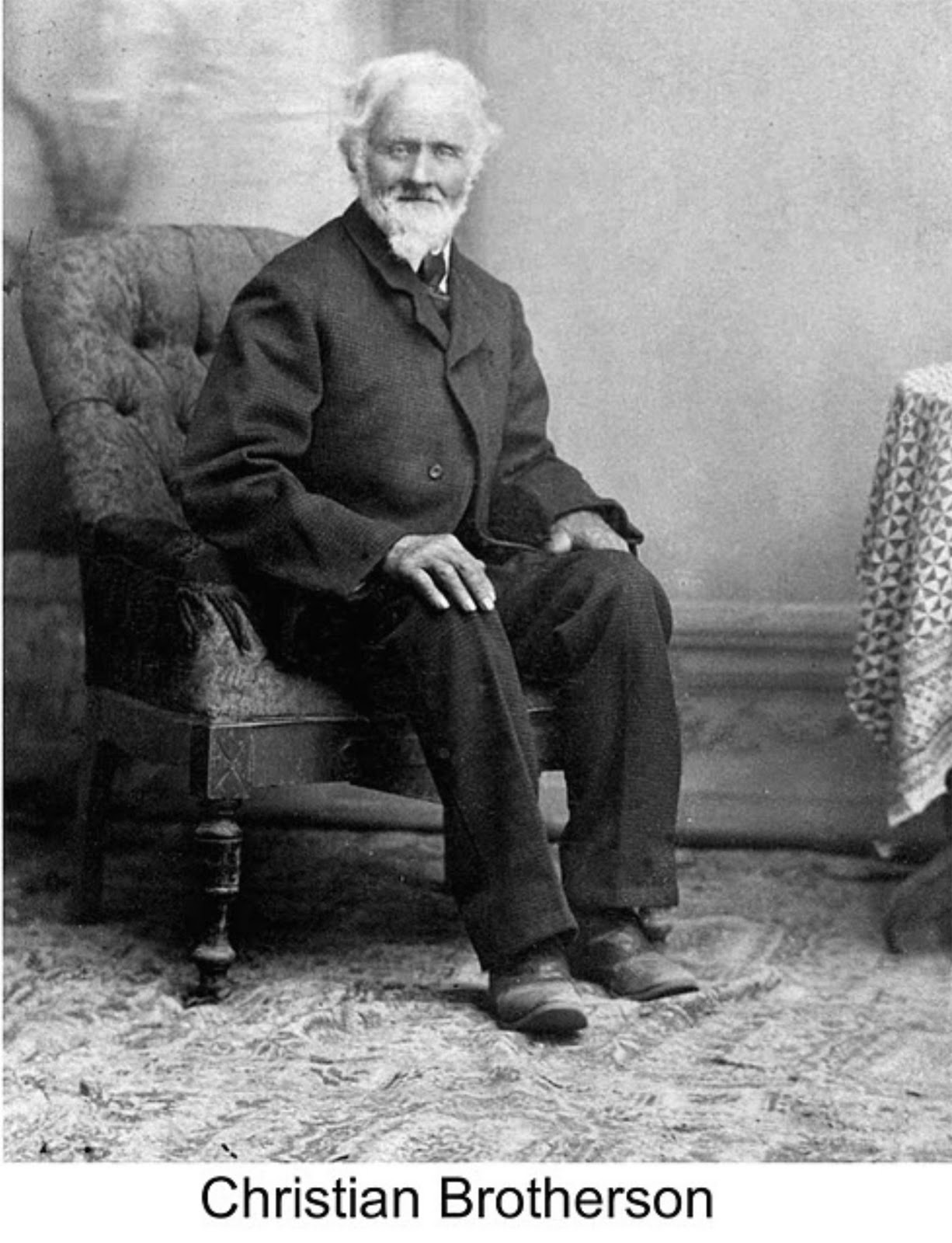
Christian Brothersen and His Family ~ Pioneers of the Month ~ May 2011


The Life Sketch of Christian Brotherson  and  His Family

The life sketch of Christen Brothersen (Brodersen) is presented in two parts. The first part focuses on the family’s early life in Denmark and their emigration to America. The second part focuses on their life in their new homeland. 

Part 1: Focuses on Life in Denmark and the Family’s Emigration

Christian Brothersen was born, 14 June 1811 at Idrstrup, Maribo, Denmark. a son of Bohne Brothersen and Anne Margrette Rasmussen. At the age of thirty-five years, he married, Anne Mortensen on 13 February 1846. Anne was born 3 February 1824, a daughter of Martin Jensen Menboe and Dorthea Knudsen. Three children were born to Christian and Anne in Denmark: Dorthea was born 19 Dec. 1847; Hans on 15 Feb 1849; Bohne on 4 April 1851.   

A sorrowful event occurred in this family when Bone was an infant of only a few weeks of age. The mother, Anne Mortensen Brothersen. passed away on 26 May 1851. Mainly out of symphony for her sister’s children; Elsie Mortensen went into the Brothersen home, married Christian and cared for the children. It seems that Christian was a wealthy man. When missionaries of the Church of Jesus Christ of Latter-Day Saints visited his home and brought the message of the restored gospel, the father embraced it with all his heart, as did Elsie.  Quick preparations were made and this family planned on going to Zion. Two children were born to Christian and Elsie; Martin, who was born 30 May 1853, at (Faister?) and Ane who born on 8 Jan. 1856.


Map showing the location of
Idestrup, Denmark, the home of
Christian Brotherson


The following year, 1857, this family joined a company of emigrants and sailed to America. Hans was Seven and Martin was only three years of age at the time. (Reference -pp 401- 403  Vol. 6. "Heart Throbs of the West" a History of the Daughters of Utah Pioneers.) The company journeyed westward immediately. At Iowa City, Iowa, they became a part of an Overland Emigration Company and were outfitted there and were bound for Utah, beyond the plains.

There were 330 people, 3 wagons, and 68 handcarts with which to make the journey. The journey was hazardous and eventful. The leader also walked and tried to keep up the spirits of his people. On13 September 1857, the company arrived in Utah, with a division of the United States Army hot on its heels.  They with many others, moved southward from the Salt Lake Valley into Sanpete


           Brothersens on the Passenger List of the Westmoreland (1857)
                        (Family Members are Indicated by Arrows)


Christian Brothersen settled his family at Fort Ephraim where the settlers from Springtown, or the Allred Settlement, had fled for protection from the Indians. They remained there until early in 1859, when

Christian went to Mount Pleasant to assist in the building of the fort. This was completed in July of 1859. Like many others, the family lived in dugouts, until log or adobe houses could be built.

After moving to Mt.  Pleasant, the Brotherson family went through a period when they had only a small bit of wheat for food which they kept in one corner of the room.  Each day, Christian would prey that they could make the food last until they could get more.  The Lord did bless them and the food did last so that the family did have something to eat.


Martin moved to Indianola to plant and cultivate crops. They also had cattle and sheep. Those were the days that tried their soul, Hans, Martin, and Christian Brotherson and other members of the family stood guard against Indians led by Chief Black Hawk from April 1865 until a treaty of peace was signed in Mt.  Pleasant at Bishop Seeley’s home in 1872.

A close up map of the location of Idestrup, Denmark


Part 2: Focuses on their Life in Utah


BIOGRAPHY OF CHRISTIAN BROTHERSEN (BRODERSEN)
by Ila Brotherson Tidwell

My great grandfather, Christian Brotherson, was one of the noble pioneers who entered the Salt Lake Valley in 1857. He it was, who gave to our family our pioneer heritage, a gift for which should be forever grateful and thankful. It is a great challenge to us as his posterity to achieve through our own efforts. We must improve and build upon the faith, standards and ideals he so valiantly preserved for us. It was he who looked beyond his own time; he had the foresight and vision. He saw the necessity of freedom. He accepted the restored gospel of Jesus Christ when missionaries came to his door. It was his soul who first accepted the principles and truths that has been a guiding star for us to follow. It was he who had the faith and courage to want to establish a new home and new way of life for his family and posterity.


Christian Brotherson was not only a pioneer, he also helped to conquer this western land and make it a frontier civilization. In doing this, he gave us a land of freedom in which to live. He gave us the opportunity to live under the protection of the Stars and Stripes of America. It is a glorious privilege and blessing to live in a land, where by our own choice, selection and work, determine our progress and status in life. He also represented the vision, faith, culture and strength of our ancestors in the Old Country of Idestrup, Maribo, Denmark.


He was born 14 June 1811. One record says Idestrup the other says Veggerlose, Maribo, Denmark. His father's name was Bohne Broderson Magnesson. He came from Germany as a German Soldier to Denmark. He married Ann Margrethe Rasmussen. They had a family of ten children. The first four were boys and the last six were girls. Christian was the second son. This is all we know of his childhood.


Grandfather married Ann Mortensen in Denmark on 13 February 1846, he, being thirty-five years old and Ann only twenty-two. There were three children born to this couple. Dorthes Brotherson, born 18 December 1846; Hans Brotherson, born 15 February 1849; Bohne Brotherson, born 3 April 1851. From what we can get from memories handed down---the young mother had complications from the last childbirth. When the little son, Bohne, was only six weeks old, his mother, Ann, died. This was 26 May 1851. She left three small children under four years of age to the care of her husband, Christian. The family was very fortunate in having Ann's younger sister, Elsie. She came into their home and cared for this new baby, a little girl four, and a small boy of two. This was a handful for Elsie, but she loved and wanted to care for her sister's children.


This presents a sad beginning in the life of Christian Brotherson. He did not loose the desire to care for his babies even though his heart was broken at the loss of his sweetheart in the beautiful years of their youth. Those who know grandfather, lived with him, those who lived near him and those who remember him now, tell us he was a devoted and kind father from the very beginning. He was now forty years old and had always had responsibilities on his shoulders. It hadn't been too easy living in a family of twelve children. Each one must take his share of the load. Great grandfather, being old when he was married, had accumulated much. He was prepared to stand on his own two feet. We have a tithing receipt given him in Denmark in 1857 for 349.00. That was a big tithing to be paid in the Old Country at one time. This tithing receipt is really very valuable. There aren't many in keeping. It was issued before they counted money in Krones. Money was then rigs dollars. I took this tithing receipt to Johanna Madsen, who is from Denmark.

She said we should have it put in a museum so people could see it. It was among the first tithing receipts given in Denmark.


Maybe it was the feeling of loyalty and responsibility for the children of her sister; we hope it was love for both the children and their father that prompted Elsie to become a mother to Christian’s three small children. They were married on March 19, 1852 in Denmark.

These children were very fortunate in having a second mother come into their home to help care for them. But as the story unfolds, Great Grandfather Christian had more dark clouds on the horizon as well as sunshine.

During the time, or shortly after he married Elsie, while they were still on their honeymoon, missionaries from America, representing the Church of Jesus Christ of Later-Day Saints, (Mormons as they were called) knocked at their door. Christian said in his own words, "I know from the first, their message was true." Erastus Snow brought the gospel to these Scandinavian people. Maybe it was he who knocked at Great Grandfather's door. However, he and his wife, Elsie, soon become loyal converts to the Mormon faith. There were two children born to this union.

Their first, a baby boy, was born 14 May 1853. They named him Martin after his Maternal Grandfather. On January 8, 1856, a little girl came to bless their home. They named her Ann. (Her home was where the Pioneer Relic Hall now stands in Mt. Pleasant, Utah).

After the Restored Gospel had come into their lives, their ideals and ambitions were to come to America. When their little boy, Martin, was only five; their baby girl only eighteen months old, they decided to come to America.

This was a big sacrifice in those days, as well as a blessing. They had to part with friends and relatives, home and it's comforts, worldly possessions, all for the Gospel of Jesus Christ and the desire to worship God in a new world. Their ideals as parents were high education, culture, patriotism, and freedom was the pattern of their lives, the desire for their children.

They were patriotic and loyal to the Church they loved so much. Great Grandfather was a well to do man in Denmark. He had servants who helped care for household and did much of his work. When he was almost ready to come to America, he hired a man by the name of Hyrum Arnoldsen to help him and his family to America. He paid his way to this new land.

They sailed on the Westmoreland, from Liverpool, 25 April 1857. The leader of their company was Matrthias Cowley. There were some 544 souls who come to America on this ship.

They landed in Philadelphia. It was only two months since they had left their home in the Old Country. On 15 June 1857 they were prepared to begin their trek across the plains to the Great Salt Lake Valley.

They joined the 7th Handcart Company under the leadership of Christian Christiansen. (Interesting to me was this notation. He was the first Elder ordained in Scandinavia. This was done by Erastis Snow in 1851.)

There was much to be done in preparation for the journey to Zion. The conditions they had left in their homeland were heart rendering---friendly relationships and family ties were often broken. Fathers, Mothers, sisters and brothers became almost strangers. Many showed enmity towards their loved ones, who had embraced Mormonism. With sad and broken hearts, but with the testimony burning in their soul, they faced another new experience different than crossing the water. Now they must pull a handcart across the plains. These activities were carried out with joy and anticipation.

There were 330 souls in this company, three wagons, and 68 handcarts. Rightly, it was named the "Christian Christiansen Handcart Company". In one these handcarts were all their possessions. Christian had a family of five children, his wife, himself and a hired man. He had a baby of two who had to ride or be carried and a little boy almost five. I have heard him (Martin) tell many times how he walked all the way, or most of the way, barefoot. His feet were so callused that he could step on prickly pares and not even flinch. He told how happy he was when his mother would pull the handcart and his daddy would carry him a little way. He also told of how his father would hold him at night until he went to sleep. He also told how he liked to see the campfire at night, hear them sing, climb on his daddy's lap and go to sleep.

They built fires only once in a while because the Indians were beginning to attack the Saints. In fact the first attack they had by Indians was in 1857.


The weary travelers moved slowly every day, stopping only long enough to eat and sleep. Behind them was the Johnson Army. They preferred to keep out of their way. But one afternoon some supply wagons that were ahead of the army caught up with the handcart company. They moved slowly pulling the handcarts and so many walking. The army had a lame oxen. They told the pioneers they could have half if they would dress it by the next evening. During the night a heavy rainstorm made the roads so muddy the army wagons mired deep in the mud and moved very slowly. The Saints pulled their light carts out of the ruts and moved on, soon leaving the army wagons far behind. The Saints had all the oxen. That night they camped near a large stream of water. The Indians helped the women and children across the stream. The Saints didn't ever see Johnson's Army again.

They had many hardships but I feel my Great Grandfather was really blessed. He and all his family reached their destination.

Here is one experience Grandpa told that happened while coming across the plains. A little girl that was the same age as baby Ann died. They had nothing to bury her in, so they wrapped her little body in a blanket, put her head in a brass kettle to keep the dirt from her face and placed her in a lonely grave. These were the heart-rending experiences that tested their faith. Sometimes they felt they couldn't carry on.

One of the abilities that God gave us when he created us was the ability to see ahead, the vision to do today what will be best for us tomorrow. Great Grandfather's faith was really tested.

Besides the hardships they endured crossing the plains, he could see every day he was loosing his wife's love. For reasons we do not know, she became the object of another man's desire to covet a lovely woman. Great Grandfather was very kind and understanding with her. He loved her very much. He needed her to help rear their children. His oldest girl was only nine years old. He had a baby only two and three other children. They all needed a mother's love and tender care. Christian told her this, "If you are dissatisfied, I will not prevent your leaving." He must have been a good man with an understanding heart. The man who took his wife was none other than the man whom Great Grandfather had hired to help him while crossing the plains. He had paid his way and in return Mr. Arnoldsen took his wife. We can't find if Great Grandfather took his wife with him into the settlement at Ephraim or if when they reached the Great Salt Lake Valley she went with this other man.

They reached the valley on Sunday, 13 September 1857. They lacked two days of being three months crossing the plains. When they had finished their journey over, in fear of Johnson's Army, most of the company was sent by the church leaders to Ephraim. The tired souls struggled on to Fort Ephraim. There Christian housed his family in a cellar or dug-out until the spring of 1859.

I have read from history that trail of the Saints, who went to Ephraim, could be followed by blood on the snow. The first winter they almost starved. Grandfather Martin tells of the winter of 1858 when they only had a little mound of wheat, in a corner to last until the next harvest. His father would raise his hands, close his eyes and pray to the Father in Heaven to bless this little bit of food that it would last them. Martin, only a boy, testified that it seemed to not diminish very fast and it lasted so that these faithful pioneers could subsist until the weeds began to grow in the spring and they could dig roots to eat.

My heart aches for Great Grandfather Christian with the sadness that he must carry in his heart alone. He had five children under ten years of age whom he must love, instruct, feed and care for. He must be a mother and father to them. What his faith and courage must have been. We owe him so much.

In the spring of 1859 he came among the first settlers to what they called Hamilton Settlement. He helped to build the stone fort. His name appears on the Pioneer Monument erected in honor of the first settlers. He took up land and built his first home in America. It was on the corner just south of where Alton Brotherson now lives. He lived in a cellar or dug-out until he and his boys finished their first home in Hamilton Settlement which later became Mt. Pleasant.

They lived here until the children all married. Then Christian moved to the north part of town. This was in his declining years. They say even then Great Grandfather's home was the play ground for all the neighborhood children. He always had lump sugar, raisins, or candy to give to them. Sometimes when he didn't have these, he would give them an egg and let them take it to the store and get what they would like. Many people of Mt. Pleasant have told me Christian always wore a long beard, and it was white as long as they could remember. If the children loved to play around his door, I think the story of his life and what he was has been pictured.

After his wife, Elsie, had gone with the hired man, they settled in Ft. Green. Later, they moved to Moroni where they made their home. Great Grandmother Elsie regretted what she had done before very long. She wanted her children but her new husband did not. She would come and get the children and have them one or two days. She still loved them and realized she had made a mistake. When they were with her, her new husband was mean to them.

One time, when Martin, my grandfather, was only seven, he was going from Mt. Pleasant with Arnoldsen to see his mother. They got to what we all know as Fiddler's Green. Later it was known as Riverside  Park. (It was a dance hall, race track, and swimming pool). A nice place at one time but it was rather wild and was disbanded. They said they called it "A place between Heaven and Hell".

Arnoldsen stopped the wagon and told Martin to get out. He said he was going to stop and water and rest the horses. So the little fellow climbed down from the wagon. The man hurriedly whipped the horses to a run and drove away. The child was astounded when he realized he was left alone and it was getting dark. He was all alone, the Indians were real ferocious. He might get lost or even perish in the darkness of the night. He sadly thought, "What shall I do, go home to Dad or go on to see Mother?" He quickly made up his mind and began to run after the wagon. He thought, "If I can just stay far enough behind so he doesn't see me but I can see the dust of the wagon, I wont' be afraid."

After separating from his step-father, he fairly flew. He began to tire after he had followed a trail out through the fields and over the hill for a long way. It was a shorter way. He said, "I prayed in my heart as I ran faster and faster that the Lord would help me get to my mother first. I did get to Mother before he did and told her what he had done." Grandfather tells of how his mother took him in her arms and cried like her heart would break. "You must go back and live always with your father. He is a good man and will always be good to you." When Arnoldsen arrived, he was surprised to see the boy and also angry. He made Martin go to bed without any super. Great Grandmother sent him home the next day with a friend as I remember. I do remember what his father said to him when he returned, "My little Mart, I felt I should never have let you go after you had gone."

On another occasion when Martin was helping Arnoldsen haul hay, he was pitching the hay on the wagon and I felt impressed to move. He looked up just in time to dodge a pitch fork. The man had aimed it at his head.

Martin tells this story about his boyhood also. "I went for a walk up in the hills. I was sitting on a big rock, I felt the presence of someone, I knew not whom. I knew I was being watched, likely by Indians. What should I do? Suddenly, I began singing loudly, so I could be heard by anyone nearby. The fear left me; I was not molested or harmed, for which I was thankful."

Great Grandfather Christian probably loved or had a great deal of respect for Elsie. He always knew how she was and when she needed help. Grandfather said, "My father often took her flour, meat, fruit and other foods and clothing for her and her children." She had a real hard life and many times didn't know which way to turn. Her husband lived in polygamy. He had four wives. It was hard for him to care for all in those days.

Great Grandmother was a beautiful woman. She had light brown hair with beautiful dark blue eyes. She was slender and average height; had a pleasing disposition but was quiet. Sometime in her life she hurt her shoulder. Some say it was from her helping pull the handcart across the plains. We don't know. But we do know her one shoulder drooped and hurt all her life.

She was sealed to Arnoldsen in the old endowment house in Salt Lake City on 16 August 1862. She told Christian many times she wished she could break that sealing.

She didn't want Arnoldsen. Christian[1] evidently wanted his first wife because he went and had her sealed to him 19 September 1889. His children were married at this time and so they made the choice of who they would be sealed to. My Grandfather, Martin Brotherson said, "I want my father." He was sealed to his father and his mother's sister, Ann, Christian's first wife. Christian died on 9 August 1893. He was buried in Mt. Pleasant City  Cemetery. Christian was 82 years old when he died. Elsie was 67 years old when she died. He lived a year and four months after she passed away.


A picture of the Hans Brotherson family circa 1901

Soon after the Death of Hans Brotherson
Background:  Hans Brotherson .(In Picture Frame)

Back Row (Left to right)t: Parley [Parley Pratt], Tina [Clementine], Francis [Francis], Boone [Bohney], Lora [Lorenza Christine], Hans [Hans}, Chris [Christian],


Middle Row (Left to right): Orsen [Orson Hyde], Rakkie, [Fredrickka], Rhea [Maria], Maggie [Annie Margaret], Grandma Frederikka [Frederickka Andrea], Nels [Nels Douglas]


Front Row: Floyd [Ferdnand Floyd] on the left, Vernon [Vernon Hamlet] and Heneretta [Heneritta] on the right.


A Portrait Picture of Hans Brotherson 


[1] Christian Brothersen (Brodersen) was endowed in the Salt Lake Endowment House on 8 July 1865.


Friday, March 18, 2011

Before and After ~ Many Thanks to David R. Gunderson


I sent the above picture to our friend David as a joke, thinking it would be too hard a challenge for him to restore this photo of his Aunt Hilda and her friend Eva.  He fooled me.  We are so thankful to have so many talented friends out there.

David has done a number of other restorations for us.  Sincere thanks to you Dave.  Kathy


Saturday, January 1, 2011

Erick and Caroline Gunderson ~~~ Pioneers of the Month ~~~ January 2011


Our friend, David R. Gunderson, has just published a book entitled “Erick and Caroline Gunderson’s Journey of Faith from Norway to Sanpete”. He has been assisted by a cousin, Betty Gunderson Woodbury. Both are contributors to our Mt. Pleasant Pioneer Blog. David has been working on this book for a long time. His research and personal knowledge of, not only the Gunderson family, but also of Mt. Pleasant history is extensive. Betty has been working on the family genealogy and collecting items of Utah family history all of her life.


With David’s permission we post January’s Pioneers of the Month: Erick and Caroline Gunderson, excerpts taken from the book.


In times of crisis, the fate of peoples and nations is often described as "hanging on a thread".  In fact the fate of our Gunderson family did hang by the threads that held a big black button on the foul weather smock that Erick was wearing during a storm on the North Sea.  During this storm, a huge wave crashed over his small fishing boat and washed him overboard.  He was able to get back to his boat, and save his life (and that of our family), because this button caught on a line or a piece of netting that was trailing out from his boat and the button's threads held.


Erick brought this button with him when he came to Utah and my Uncles Doug, Shy, and Glen recalled of playing with it when they were children.  It would be nice to have this button now but it has been lost.  But it must have looked like the one shown here.


The families of both Erick and Caroline lived in Riser, Aust-Agder (East-Agder) Provence, Norway, which is a small fishing and resort village located about 125 miles south of Oslo. It borders the North sea and Oslofjord. Risor was known from Viking days for its strong ships and expert seamen. Like all Norse communities , it had a tradition of Viking raids on England, France and other parts of Europe. In the early 19th Century, Risor, though small, had become an important shipping center in Norway and roughly 100 sailing ships made it their home port. It was in this small community on August 27, 1830, that Erick Gunderson, a son of Gunder Ericksen and Annie Jensen, was born into the world.


At this time Norway was actually a part of Sweden, having been annexed in 1815 from Denmark at the close of the Napoleonic wars, after nearly 400 years of Danish rule. Opportunity for education above elementary school was not readily available to the people of Norway, unless they were a member of the clergy or of the aristocracy. The family had always been close-knit and must have had the means to allow the children to receive a little better than the average education and training. (At this time, Norway was still using patronymic names so Erick Gunderson’s father’s name was Gunder Ericksen) Not much is known about Erick’s growing up years, but he was a fisherman by trade and probably went to sea with every fishing expedition available to him in order to help meet the family’s needs.


The Aurora Borealis as seen from Norway.  Erick and the other members of the family would have been familiar with these spactacular sights.


The family must have enjoyed all of the wonderful Norwegian festivals. They would have especially enjoyed the Yuletide celebration with rice pudding, and small prizes, and coins hidden in the Yule cake. They must also have looked forward to the Midsummer Festivals with all of its traditions as well.


In about 1851, when Erick was 20 or 21 years old, he went to Scotland (Glasgow) to learn the trade of shipbuilding. It is not known how long he apprenticed in Scotland, but it was probably for a period of about one year. Since English is the common language among the sailors of the North Sea, Erick must have had some command of the English language before he went to Scotland. While there, his English skills probably improved markedly. This must have aided him greatly when he came to America.


The first Mormon missionary to Norway was Elder Hans F. Petersen. He was brought to Norway by a Norwegian sea captain, Svend Larsen, of Osterrisor (Risor), who had become interested in the message of the church, while delivering a load of lumber at Aalborg, Denmark. Elder Petersen arrived on 11 September 1851 and with the help of Captain Larsen began to lay the foundation for the work on the next day. In Norway the missionaries received a mixed welcome. Some Norwegians readily accepted them and embraced the Gospel, while others tried to have them jailed or expelled.


It was to this situation that Erick returned to Norway from Scotland. Some members of his family had heeded and accepted the Gospel. Other family members were bitterly opposed. As a result, Erick withdrew from the family, decided to just ignore the Mormon problem and married his childhood sweetheart, Inger Elizabeth Evensen on 13 January 1853. Some of her family members had also accepted the missionary’s message and joined the new Church but she apparently remained indifferent.


Saddened by his lack of interest in this new religion, his younger sister, Torbor, pled with Erick and Inger to just listen to the Elders and then decide. Finally, they agreed. He and Inger soon accepted the message and were baptized on 23 April 1853. He was the 35th member and she the 36th member added to the Church rolls in Norway according to the records. His father, Gunder Ericksen; his mother, Anne Jensen; his sister, and other family members preceded them as members. His parents joined the Church 19 September 1852. The first baptisms in Norway were on 23 September 1851. (Note that Erick’s future wife, Caroline and her blind mother Maria became the 7th and 8th members of the church in Norway on 25 June 1852.)


Svend Larsen, the ship captain who brought the first missionaries to Norway was baptized 23 September 1851 in Aalborg, Denmark. He immigrated to Utah in 1854.


About one year after they joined the LDS Church, Erick and Inger were blessed with a beautiful baby girl who they named Anne Torine. She must have been a wonderful and welcome addition to their home.


Erick, along with other family members, heeded the call to gather to Zion. In mid-November 1854, Erick (age 24), Inger Elizabeth (23), their daughter, Anne Torine (nearly a year old), his father, Gunder (50), his mother, Anne (48), his sister, Torbor (18), his brother Jens (22), Jens’ wife Anne (22), Erick’s Uncle and Aunt Henrik (36) and Ingeborg (35) Erickson and their family, Erick Bertel (13), Torborg (10), John Andreas (5) and Ingeborg (6 months), departed their beloved Norway together. However, due to a problem with ships in Liverpool, Jens and his family had to cross the Atlantic on the next ship, the Charles Buck. Karen Dorthea, and her husband Niels Johannes Petersen probably stayed in Norway to settle up the estate and to care for their grandparents Erick and Torborg, who died in 1857 and 1858 respectively. The Petersons emigrated in 1863.


One cannot help but wonder how the family members felt as the familiar scene of the Risorflekken, the large white stone, that marks Risor harbor, faded into the distance for the last time, as they sailed out into the North Sea. This would be the last sight they would ever have of their beloved home town, Risor.


The first leg of this trip was from Norway to England. This passage was carried out on a 132-ton Danish paddlewheel steamship called the Cimbria. This voyage has been clearly described in the book “Saints on the Sea”. “There is no other body of water quite like the North Sea. It is often unpredictable, violent and treacherous - - and particularly so during the winter monts. Of all the North Sea passages made by Mormon emigrants, probably none was as terrifying as that of the small Danish steamer Cimbria. It left Copenhagen on 24 November 1854. Some 300 Scandinavian Saints were crowded on board when the 132-ton paddle-wheeler sailed out of the harbor. Although the sea was very rough, the Cimbria reached Fredrikshavn on the east coast of Jutland the following morning. There 149 additional emigrants from Aalborg and Vendsyssel joined the company, further crowding the 160-foot ship. (Our Gunderson family members probably crossed to Denmark to join this company of emigrants at Fredrikshaven.)


On 26 November the steamer resumed her voyage and the weather was fair until the next afternoon. Then a strong wind came up, and its rising fury forced the captain to seek haven in the nearest Norwegian port. He put into Mandal (formerly known as Vesterrisor), an excellent harbor sheltered by high and steep granite cliffs. Here the Norwegians offered the Saints accommodations on shore for several days until the wind diminished. The elders preached to some of the villagers, and several were later converted.


On 7 December the Cimbria once again put to sea, but the improved weather soon changed for the worse. Before the end of the day a violent storm struck. The waves became mountainous, and the wind shrieked through the rigging. Tons of water crashed over the bow, shattering the bulwarks and some boxes on deck. The captain once more sought safety in Mandal’s harbor, but the strong currents and winds made it too dangerous to head toward Norway. The vessel returned to Fredrikshavn, where she anchored on the ninth. During this storm the emigrants huddled below decks, suffering from the cold, the pitching of the ship, and seasickness. Once on shore again, a few of the less hardy refused to travel farther, but most of the Saints recovered their courage and even held public meetings.


It was not until 20 December that the captain felt the weather would permit setting out again for England. For a day the sea was favorable, but the following night the storm returned with the appalling savagery of a mindless beast. Great masses of water threatened to capsize the little steamer, and the twisting troughs between waves seemed designed to break her back. For hours the Cimbria battled the ferocity of the winds and the high seas, while the miserable passengers were too cold and sick and too busy holding on to their bunks, tables, or anything secure to think of much else but prayer and survival. The vessel, shuddering and quivering with each wave, tried to turn back for a third time. Then, in the afternoon of the twenty second, the wind veered to the north. The captain changed course and continued on to Hull. On 24 December the battered steamer with her exhausted crew and thankful passengers anchored in the River Humber. The following day-Christmas-the Scandinavian Saints traveled by rail from Hull to Liverpool, where most boarded the Yankee square rigger James Nesmith bound for New Orleans.”


The Cimbria passengers arrived a day or two too late for the ship they had been scheduled to use, and the Church Immigration Agency hurriedly located the ship James Nesmith. It was quickly equipped for passengers and on 7 January 1855, with 440 Scandinavian Saints, and one English Saint, it sailed for America. (The ship being too small for the whole company, 24 people were left to come later. Jens and his family were probably among these.) The company leader of the Saints on board both the Cimbria and the James Nesmith was Peter O. Hansen, a returning missionary. The voyage began with the ship being towed out of the Liverpool harbor down the river Mersey, past the light house and into the open sea where the sails were unfurled and a course was set for the new world.


During the winter, the prevailing winds in the North Atlantic are westerlies, and emigrant ships had to tack (sail into the wind) for most of their crossings. This results in a fairly rough and long voyage. However, crossing the Atlantic in the winter made it possible to cross the plains in the summer and this was crucial.


Many of the Mormon emigrant ships had wonderful choirs which performed during the dedication and prayer for safe journey services which were always held at the outset of each emigration voyage. One of the great gathering hymns, “Ye Elders of Israel” with its inspiring message, “O Babylon O Babylon we bid thee farewell, we’re going to the mountains of Ephraim to dwell” was one of the favorites. Both the emigrants and many of the ships officers and seamen took courage from these dedication ceremonies and the continued prayers for safe voyage. Over the 30 years of emigration by sail only one vessel, in 176 was lost.


After a 47 day passage, the James Nesmith arrived in New Orleans on 23 February 1855. The passenger list that was presented to the New Orleans Customs Office shows that the family had all arrived safely, except for Anne Torine who had died on 20 January.


The 1850s travel on the rivers was fraught with many dangers. Among these were diseases, especially cholera, exploitation by unscrupulous gamblers and boat personnel, running aground or being caught on a snag, sinking, falling overboard and being ignored, thievery, etc. However, until 1856, when the railheads were extended to Iowa, it was the best means of transportation available. The Charles Buck, on which Erick’s brother, Jens traveled, was the last Mormon emigrant ship to land at New Orleans. It departed from Liverpool on 17 January and arrived at New Orleans on March 14, 1855, after a 53 day passage.


Within a day or two after their arrival the Gunderson/Ericksen family began their voyage up river. Two steamboats, the Moses Greenwood and the Oceana, carried James Nesmith travelers to St. Louis, where they arrived March 7. Those who could not immediately afford passage to Salt Lake City took the steamboat Polar Star to Weston, where they sought employment.


On March 12, 1855, about 175 of the Mormon emigrants from the ship James Nesmith resumed their passage from St. Louis to Atchison, Kansas aboard the steamboat Clara. It was a trip bedeviled by delay and disease. At Leavenworth low water compelled the steamer to lay up for a time during which another Mormon company arrived. There twenty Saints died of cholera and on the way to Atchison nine more deaths were recorded. This 351 ton sidewheeler was skippered and partly owned by Joshua Cheever. A year later the Clara was sunk by ice at St. Louis.


On 25 March 1855 while the family was at Ft. Leavenworth, Kansas, Erick’s younger sister Tobor Kristine (18) married Simon Fredrick Halversen (26) from Brekke Osnoy Ostfold, Norway.


Erick’s parents, and his Aunt and Uncle, Henrik and Ingeborg Ericksen, and the rest of their family members that came on the James Nesmith, reached Mormon Grove at Atchison, Kansas in early June. There they began preparations to cross the plains and with the exception of Erick and his family, they continued west with the Secrist-Guyman Wagon Company which left from Mormon Grove on 13 June and entered the Salt Lake Valley on 7 September 1855 after a 57 day crossing. They settled in Spanish Fork and prepared for the arrival of the rest of the family.


Erick remained in Mormon Grove at Atchison, Kansas until 1856. Family records say that Inger, who was pregnant, contracted cholera. The baby, a boy who they called Earl Even, was born on 25 October and soon passed away. Inger died two days later and they were both buried at Mormon Grove. The rest of the family had left in June and it was too late for Erick to find and join a company and follow his family to Utah in 1855, so he worked to prepare to go on to Utah during the next immigration season. In 1856 he arrived in Utah during the week of the 16th of September 1856, after an 81-88 day crossing and joined the family in Spanish Fork.


A Wife for Erick Comes from Norway


Erick left Norway in late 1854 with his parents, his sisters, a brother-in-law and a small child and other family members. In 1857, two years later he was a single widower in Utah probably living with his parents. How lonely he must have been. However, things were about to get better.


As the Gundersons and other families, one by one left Risor to go to Zion, another member of the Risor Branch of the Church, Caroline Johnson, longed to go to Zion also, but she just couldn’t leave her widowed and blind mother alone in Norway. Recognizing the strong desire of her daughter to join the Saints in Zion, Maria encouraged her to go. However, Caroline always replied that she could never leave her mother alone in Norway. Finally, Maria said, “If you won’t go without me, I will have to go with you.” When Caroline asked how they could do that her mother said that “they would just face the problems, one at a time. “ In the spring of 1857, they did just that.


Maria (age 54) and Caroline (age 22) departed Norway on Saturday, 11 April 1857, with a group of saints from Christiania (Oslo), Norway and sailed to Copenhagen aboard the Norwegian steamship Viken. In a calm sea, the vessel arrived at the Danish port the following day. After a five-day delay this company-about 540 emigrants under the direction of Hector C. Haight, President of the Scandinavian Mission, boarded the Danish screw steamer L.N. Hvidt and traveled to Grimsby (just south of Hull). From that English port they traveled by train to Liverpool. Soon after they arrived in Liverpool, they boarded the ship Westmoreland.


The Westmoreland left Liverpool on Saturday, 25 April 1857 and arrived at Philiadelphia, Pa on Pentecost Sunday, Sunday, 31 May 1857 after a 36 day passage. The emigrants then boarded the train to go to the trail head in Iowa City, passing through Baltimore and Wheeling along the way.


At Iowa City, they joined the Seventh Handcart or Christian Christiansen Handcart Company which departed on 12 June and, traveling over the Mormon Trail, arrived in the Valley on Sunday, 13 Sep 1857.


One of the other passengers on the Westmoreland was C.C.A. Christensen who was a convert to the LDS faith in Denmark and had served a mission in both Denmark and Norway. Before his mission, he had studied painting and illustration in Copenhagen for several years. It is interesting to note that he lived for a time in Mt. Pleasant and took an active roll in the early developments of that community.


The Arrival of the Christiansen Handcart Company in the Sale Lake Valley


“Along the way lay the skeletons of worn out oxen, but these heroes and heroines endured …With their lips half eaten up by saleratus dust, and clothed in rags, with almost bottomless shoes on their feet, yet they greeted with songs of delight the rising sun which let them see Salt Lake City for the first time.”


“What changes have taken place since that time in less than one week our emigrants are now brought here from the Atlantic coast, where they disembark after a few days pleasant ocean voyage by steamship, while we in those days were tumbled about by sailing ships for several weeks , uncertain of the time when we could expect to see the promised land. And then the journey by land over the great, empty plains and high mountains on foot, poorly supplied with food and clothing- in short, subjected to almost every deprivation that people could bear and endure, and that for all of thirteen weeks.” (taken from Nebraska History p. 344 “By Handcart to Utah, the Account of C.C.A Christensen, translated by Richard L. Jensen)


Caroline and Erick Meet, for the second Time, and Start Life Together


On his arrival in Utah on 16 September 1856, Erick joined his parents in Spanish Fork and began to work to further establish the family in Utah. He probably worked as a carpenter and also at farming, but nothing else is known about this first year in Utah, except that we guess he was very lonely.


Caroline and her mother arrived in Utah on 13 September 1857, about one year after Erick’s arrival. As noted, they had traveled in the Christiansen Handcart Company which crossed the plains together with the Cowley Ox Cart Company in which Erick’s brother Jens Gunderson traveled. While crossing the plains, Jens and his family surely would have become acquainted with their Norwegian friends. Caroline and her mother, Maria that they had probably known for many years, maybe even from childhood, and associated with the Osterrisor Branch of the LDS Church in Norway.


Since they were friends from “home” and had crossed the plains together, it would only be natural for Jens and his family to invite Caroline and her mother to join them in Spanish Fork. Communication between family members in Utah and family members in the Midwest may have been difficult in those days, but some information must have been exchanged, if only by word of mouth. In any case it is likely that Jens knew or was able to find out where the rest of the Gunderson family was located.


How happy the Gundersons in Spanish Fork must have been to have Jens and his family safely in Utah, and to greet friends from “home”, and to get all the latest news about their friends and family back in Norway. They all must have had a wonderful reunion.


Quickly, Caroline and Erick became interested in each other and on Monday, 12 October 1857, only about four weeks after Caroline’s arrival; they were married (sealed) by none other than President Brigham Young in the President’s Office in Salt Lake City at 12:30 p.m. They were late endowed in the Salt Lake Endowment House on 22 November 1861 with B. Young, W. Woodruff, and S.L. Sprague officiating.


Imagine finding a partner from “home” in far off Utah. One that spoke your native tongue, and who remembered the Risorflekken, the midsummer festivals, the picturesque Risor Harbor, the beautiful church by the sea. One who loved all the special Norwegian foods and songs, one who knew all the old friends from “home”, and one who remembered all the other special things that you remembered from your past. Then you will know how blessed Erick and Caroline must have felt to have found each other.


On 6 September 1858, Erick and Caroline had a daughter who they named Lurine Elizabeth Gunderson. She was born in Spanish Fork and died on 28 December 1861 in Mt. Pleasant.


Erick and Caroline Gunderson Relocate to Mt. Pleasant


Considering many factors, we believe that Erick came to Mt. Pleasant in the spring of 1859. It is likely that Caroline came a bit later after the birth of her second daughter, Maria Elizabeth, which occurred on 17 Feb 1860. Therefore, Erick would have been in Mt. Pleasant to assist in building the first and second forts, to divide up the land, and to clear it for planting. They would also have participated in the defenses mounted during the Black Hawk War, probably joined the United Order and played a major role in the erection of the first Mormon Church in Mt. Pleasant. They would have participated in the building of the first plants and mills and obtaining new farm equipment.


Being a carpenter by trade, his services were greatly in demand as he helped build many of the early and later homes, churches and school houses in Central Utah. He worked on every temple that was erected in Utah during his lifetime as well as the Salt Lake Tabernacle, and for the most part, he volunteered his services.


Saturday, November 20, 2010

OUR TREES ~ by David Gunderson

Introduction to Our Trees


One fall, when my Mom got her copy of a little magazine called "Saga of the Sanpitch", She decided to write her memories of the trees that had grown along the south side of their yard or lot, as they used to say, during her childhood. “Saga” contained stories of life in Sanpete Co. Utah from pioneer days forward and Mom had plans to submit her little article to "Saga" for publication but just didn't get around to it. I recently found a copy of it and I decided to get it into electronic format so that all could have a copy.


I made a few editorial changes, added some explanatory notes, found the words of the two childhood songs she referred to on the internet, and added them in an appendix. I also found the music for the song “Come Little Leaves” on the internet and I added a hyperlink to the website which contains the music so that you can hear it. I hope that you enjoy “Out Trees”.


Some have asked if I have submitted “Our Trees” to “Saga”. I would have done so, but Saga is no longer being published. I think that the demise of Saga is a great loss.


~David Gunderson~


Cottonwood Trees


Our Trees

By Leoan Gunderson

1910 - 1998


Fall Circa 1986

It’s October again, when the fall season comes upon us, with its beautiful trees all dressed up in their finest clothing of gold, red, green, and brown and sometimes even a bit of purple shows up as a background for the beautiful fall scene, When I see it again each fall, I always think of the trees we had at our home when I was a child.
I guess the real thing that is spurring me along to write my feelings today is the little song that I learned as a young student at the Hamilton School in Mt. Pleasant, Utah. The words to the song went something like this ….


Come little leaves said the wind one day.     


Come o’er the meadows with me to play.


Put on your bonnets of red and gold,


For the summer is gone and the days grow cold.


Or perhaps it was the song that goes…


October gave a party.


The leaves by the thousands came.


Oh I do wish I could remember the rest of these beautiful little songs . But today, my memories of them have inspired me to write of the trees that grew along our sidewalk in Mt. Pleasant.


Our trees stretched for the full length of the sidewalk      

 on the south side or our lot, which was one half of

a city block long,

on 3rd North going west from State Street.


I do believe that our trees were pretty during each of their phases of live most all year long. In the spring they were adorned in that striking and welcome color of spring green. It was a delicate green and so easy to enjoy.


Of course, most everything does have one or two little distasteful things about them which we all have to endure. Our trees were cottonwood trees and each spring after the pretty new green leaves appeared they had a habit of bearing cotton. The cotton would catch a little breeze that was passing by and soon would be flying everywhere. Here I must add that at this point in the life of our Cottonwood trees, they became a real problem to my Mother and to my sister Evelyn. They both suffered from hay fever. I remember how they both wore silk masks over their noses to strain out the cotton. But this would pass – until the next cotton season arrived.


[1] See the Appendix for the word to both of these songs


Then came the summer, and our cottonwoods would stretch their strong leaf covered arms out to form an arch over our sidewalk so that we might walk up and down our sidewalk in comfort, protected from the strong glare of a very penetrating sun. Oh yes, I did enjoy this phase in the life of our trees.


But, as one season follows another, soon it would be fall again and our cottonwoods would supply me with another thrill in my young life. Our trees would begin to turn that beautiful golden color that only cottonwood trees do and I would imagine how rich I was with all of that “Gold that did grow on our trees”. One could not believe all of the wonderful imaginary things that I purchased with that easy to acquire gold from our trees.


Of course this beauty came and then gave way to the next phase in the life of our trees. This is when the wind came and sang the little song to the leaves –


Come little leaves said the wind one day        


And the leaves fell but they didn’t all go with the wind. Those that stayed on our sidewalk and in our yard became a shear delight to me, my sister Evelyn, and her friend Helen Jones. Oh we made the most beautiful houses one could ever imagine from those mounds of leaves. I doubt that any contractor could ever build or create for us a more beautiful house than the ones we fashioned for our selves with our imaginations from these leaves.


We had many rooms – they were really mansions, believe me. We had bedrooms, bathrooms, kitchens, dining rooms, and of course, what else but a lovely parlor. And people that were allowed to go into the parlor had to be pretty special. We had furniture also, and it had more beauty than anyone else’s. It’s too bad that we were the only ones that could see all of this beauty.


I am so truly glad that I had a childhood full of fantasy and imagination. I am so glad that I was allowed to create, arrange, and imagine rather than to have everything created for me. As you can see, we were never bored, and no one had to do our planning for us.


But, our trees were not through yet. One day, depending on the weather and usually a short time before Halloween, Mother would tell us, “Tonight after school you can begin to gather the leaves together and soon we will have our big bonfire.”


After we had gathered all of the leavers, which would take us two or three days, we would have a big mound of leaves that would be about like of a small haystack. Then we would go over to the Orchard of my Aunt Hilda (on the south east corner of 3rd East and State Street)


and each of us would get the prettiest big red potato apple that we could find. (I think they are now called Baldwin apples.) Each of us would also get a potato from the garden and put them both into the leaves to be roasted. Kids from all over the neighborhood would join in this fantastic event and bring their own apples and potatoes to go into the big bonfire.


Of course when the fire was out or nearly out, the apples and potatoes would be blackened or burned from the fire and smoke but would only be half done. But how could an apple or potato ever taste so good. Each boy or girl would bring their own salt shaker to shake salt on their potato each time they took another bite. The apples usually didn’t need salt.


That was truly a wonderful day for all of us. We would go to bed that night with visions and memories of the joys that had come this year and the anticipation of the joys that would come next year from our beautiful cottonwood trees.


For the rest of the fall and winter our trees would stand there like sleeping gray sentinels, sometimes beautifully festooned with ice and snow, as if gaining strength to produce more beautiful leaves and useless cotton for the next great cycle of their life. We looked forward to the coming of the leaves in the spring, to enjoying the shade they would produce in the summer, to seeing the leaves turn to that special gold in the fall, to building our dream houses when the leaves dropped, and to having another beautiful bonfire on a late October evening when the moon was there to see it all take place.


This was truly the beautiful life of our cottonwood trees.


Appendix


The Children’s Autumn Songs
That Leoan Remembered


Come, Little Leaves

by George Cooper,


Come, little leaves, Said the wind one d

Come down to the meadows With me and play.


Put on your dresses Of red and gold;


For summer is past, And the days grow cold.

Soon as the leaves, Heard the wind's loud call,


Down they came fluttering, One and all.


Over the meadows, They danced and flew,


All singing the soft, Little songs they knew.


Dancing and flying, The leaves went along,


Till Winter called them, To end their sweet song.


Soon, fast asleep, In their earthy beds,


The snow lay a coverlet, O'er their heads.


October’s Party


by George Cooper


October gave a party; The leaves by hundreds came.


The Chestnuts, Oaks and Maples, And leaves of every name.


The Sunshine spread a carpet, And everything was grand,


Miss Weather led the dancing, Professor Wind the band.

The Chestnuts came in yellow, The Oaks in crimson dressed


The lovely Misses Maple In scarlet looked their best.


All balanced to their partners, And gaily fluttered by;


The sight was like a rainbow, New fallen from the sky.


To hear the music to Come, Little Leaves, do a CTRL+CLICK on: http://www.niehs.nih.gov/kids/lyrics/comelittleleaves.htm